
Experiment
AF14
BOUNDARY LAYER
Allows students to investigate both the laminar and turbulent boundary layers on flat plates with rough and smooth surfaces.


If you have any questions or you'd like to discuss a product, please call us.
+44 1159 722 611BOUNDARY LAYER
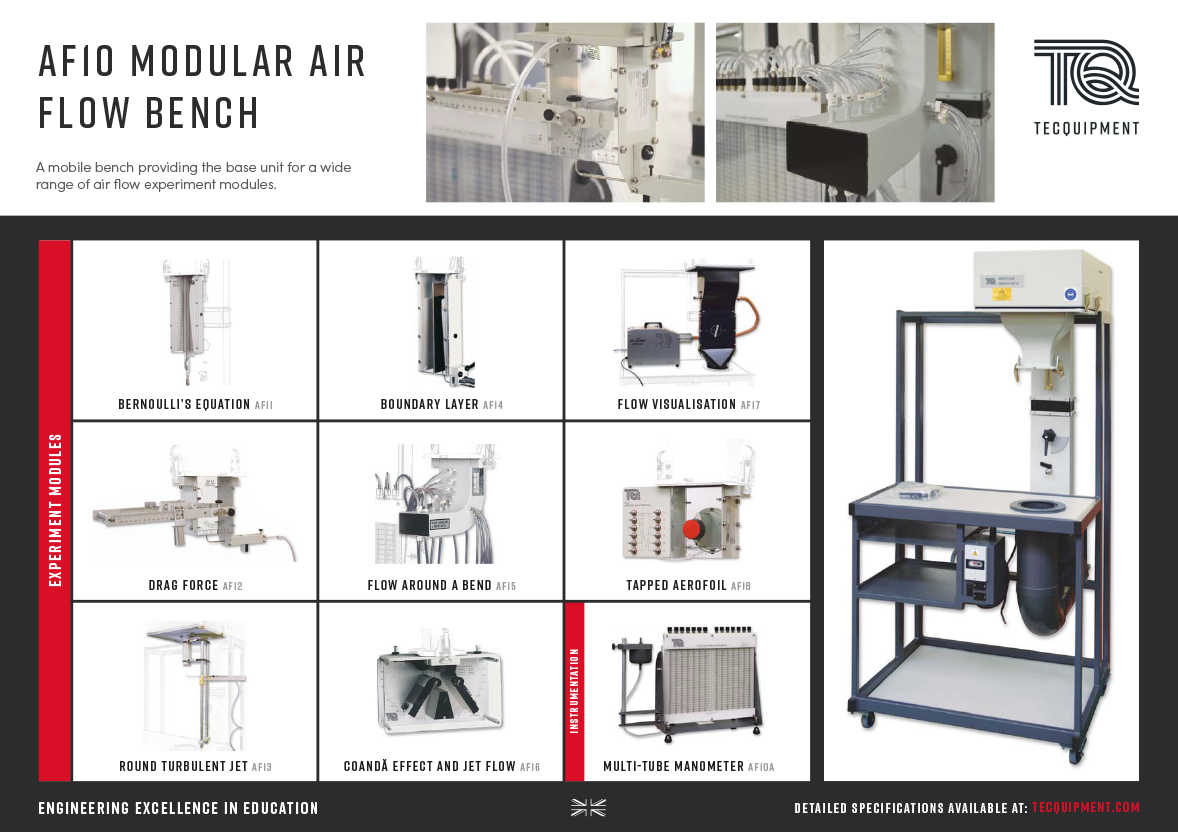
One of a series of eight experiment modules that fit to the Modular Air Flow Bench (AF10), this module consists of a duct in which there is situated a flat plate. The flat plate is rough on one side and smooth on the other, providing different surface conditions for the formation of a boundary layer. To extend the experiments, removable duct liners can be added or removed to change the pressure gradient in the direction of flow.
The total pressure (and thus velocity) at various distances from the plate surface is measured by a flattened Pitot tube which is positioned by a micrometre. The pitot tube connects to the AF10a manometer (ancillary) via a flexible tube fitted with a quick-release coupling.
Key features:
- One of a series of eight experiment modules that fit to the Modular Air Flow Bench (AF10)
- Allows a number of tests on laminar and turbulent boundary layers, with rough and smooth surfaces with different pressure gradients
- Boundary layer velocity profile is measured with a Pitot tube with a fine micrometer adjustment for best results
- Toggle clamp connections to the Modular Air Flow Bench contraction for quick and easy fitment
- Quick-release coupling fitted to the Pitot tube to allow rapid and reliable connection to the AF10a Manometer
- Test section has a transparent front – students can see the experiment and the position of the Pitot tube clearly
Learning outcomes
- Measurement of the velocity profile in laminar and turbulent boundary layers.
- Measurement of the velocity profile in the boundary layer formed over both rough and smooth plates.
- Measurement of the velocity profile in the boundary layer at various distances from the leading edge of the plate.
- Effect of the pressure gradient on the boundary layer velocity profile.

Ancillary
AF10A
MULTI-TUBE MANOMETER
Experiment
AF1300F
FLAT PLATE BOUNDARY LAYER MODEL

Experiment
AF1450F