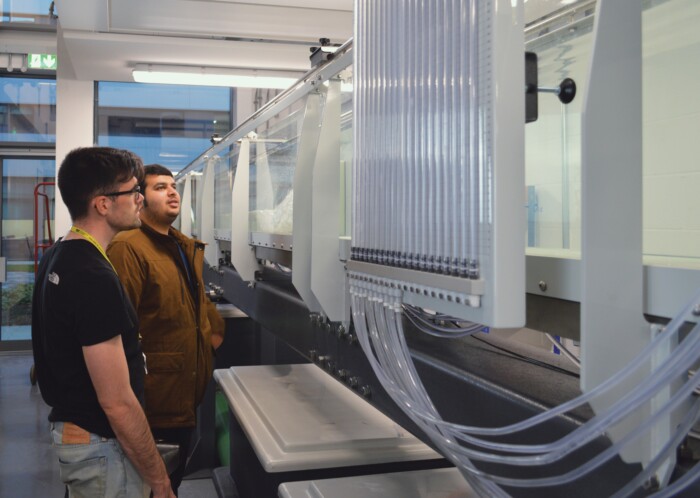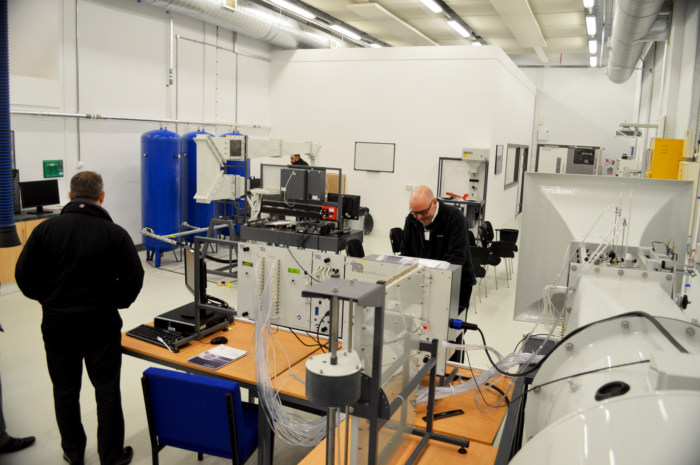
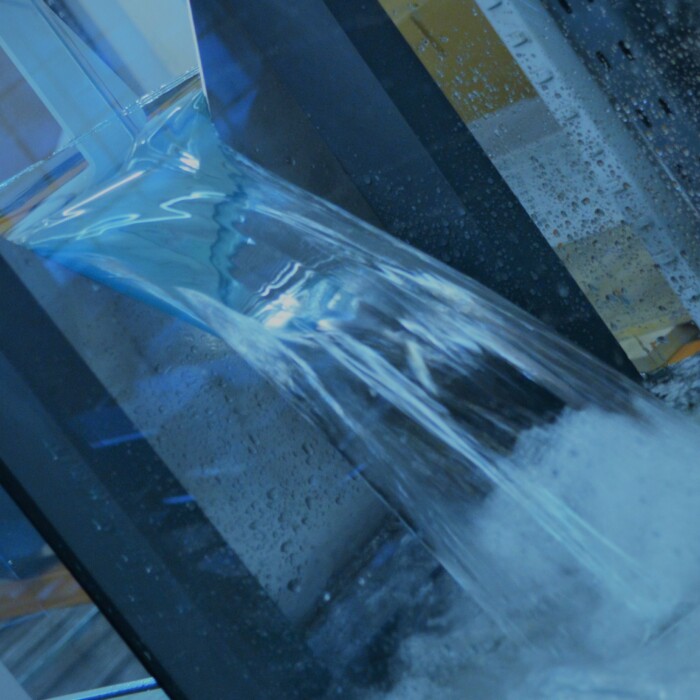
This apparatus can support undergraduate laboratories, capstone projects, and faculty research in experimental hydraulics, including studies of uniform flow, specific energy, hydraulic jumps, and velocity profiles.
Platform overview
- Modular channel: sections are configurable for the required test reach length; accessory integration is straightforward for comparative studies.
- Instrumentation: precise flow measurement and control suitable for laminar/turbulent regimes, critical/subcritical transitions, and hydraulic jump observation.
- Visual access: transparent sidewalls for qualitative observation (e.g., roller length, air entrainment) and quantitative image‑based velocimetry.
- Materials and lifecycle: corrosion‑resistant construction designed for durability and reduced maintenance overheads.
- Data acquisition: optional VDAS® for synchronised measurements (e.g., depth, head, velocity probes), logging and post‑processing.
Example laboratory exercises (indicative)
- Specific energy and critical depth over weirs: Configure sharp and broad‑crested weirs to derive rating curves, compare head–discharge relationships, and estimate uncertainty.
- Hydraulic jump characterisation: Use the sluice gate to set supercritical approach conditions and measure sequent depths, roller length, and energy dissipation vs. Froude number.
- Velocity profiles & boundary layer: Traverse Pitot tubes to map velocity distributions; compare laminar/turbulent profiles and evaluate shear stress estimates.
- Free‑surface waves and obstructions: Investigate wave generation and transmission with the wave‑maker; study afflux and backwater effects around obstructions.
Teaching design
- Create repeatable protocols with defined inflow/outflow boundary conditions, instrument calibration steps, and VDAS® logging templates to support assessment and reproducibility.
- Use the transparent sidewalls to pair qualitative observation with quantitative data (e.g., frame‑grab measurements of roller length).
- Align outcomes to typical module objectives (e.g., apply conservation laws to open channels, analyse energy grade lines, evaluate measurement uncertainty).
Research applications
The flume’s modularity and accessory range facilitate controlled studies of flow transitions, local head losses, free‑surface instabilities, and structure–flow interactions, with instrumentation suitable for parameter sweeps and scaling analysis.
Support & service
TecQuipment provides product support from installation through maintenance; the apparatus is built for long‑term laboratory use with corrosion‑resistant materials.
FAQs
What lab exercises can be run on a 2.5–15 m flume?
Typical exercises include specific energy and critical depth using sharp‑ or broad‑crested weirs, hydraulic jump characterisation with a sluice gate, and velocity profiles using Pitot tubes. Accessories and repeatable boundary conditions support assessment.
How is hydraulic jump energy loss measured in teaching labs?
Set supercritical approach flow with a sluice gate, measure sequent depths and roller length, and compute energy loss from specific energy before and after the jump. Use data acquisition for multiple replicates.
Which weir type is recommended for rating curve calibration?
Sharp‑ and broad‑crested weirs are both used. Sharp‑crested weirs offer well‑defined head–discharge relations for calibration; broad‑crested weirs support studies of subcritical/critical transitions.
Can VDAS® integrate external sensors (e.g., pressure transducers)?
VDAS® supports digital logging and analysis for hydraulic experiments; integration options depend on the sensor interface and module specification.