

Experiment
MF40 MKII
MATERIALS LABORATORY WITH DATA CAPTURE
A versatile benchtop machine for compressive and tensile tests on different materials and structures.




If you have any questions or you'd like to discuss a product, please call us.
+44 1159 722 611MATERIALS LABORATORY WITH DATA CAPTURE
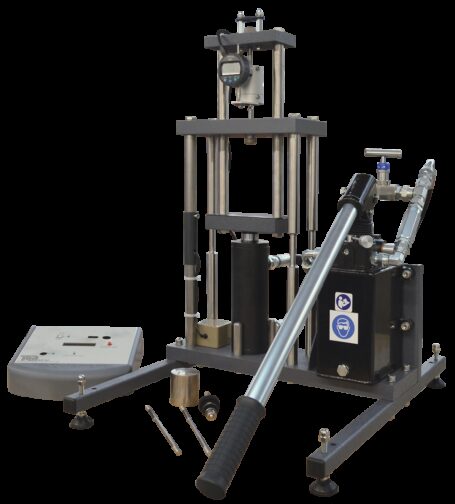
A hydraulic tensile and Brinell hardness testing machine. The machine tests any suitably shaped specimens of various materials. The material must not exceed the maximum strength or hardness limits (see ‘specifications’ on the data sheet). TecQuipment also supply additional low-cost test specimens (available separately).
The main parts of the equipment are:
- A load frame
- A display unit with a digital display of force (load)
- A ball indenter for Brinell hardness tests
- An extensometer with a digital display for tensile tests
The load frame is mounted on adjustable legs and can be fixed to a bench for stability. To apply loads, students pump a handle connected to a hydraulic ram.
The display unit shows force and works as an interface to send data to a suitable computer. The extensometer has a digital display of extension and connects to the display unit for data capture.
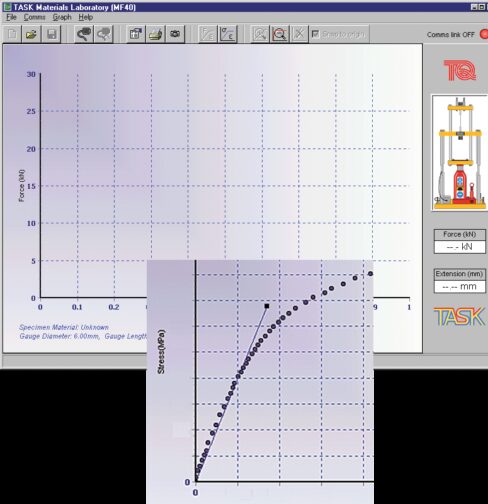
Included is TecQuipment’s MF40 MKII software to allow students to use the equipment with a computer (computer not included). The software records the data and produces detailed graphs of force against elongation and stress against strain.
Typically students will work in small groups, with one student working the hydraulic ram, while others note readings or use the software.
To do a hardness test, students put a hardness specimen on a platen and lock a guard in position. They apply a suitable load with the ball indentor and measure the impression in the specimen. They then use an equation to calculate Brinell hardness.
To do a tensile test, students fit a specimen to the machine, attach the extensometer to the specimen, and zero the display unit and extensometer. They then lock a guard and apply loads, taking various readings, until the specimen breaks. Students use the results to find the ultimate tensile strength, the proof stress and Young’s modulus of the material.
The Materials Laboratory comes with a user guide that shows experiment methods, information, references and tips.
Recommended Ancillaries:
• Additional tensile test specimens of different materials:
• Hardness test specimens of different materials:
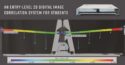
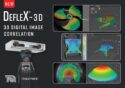
• DefleX® a complementary tool designed to introduce students to the concept and technique of Digital Image Correlation (DIC). This product is compatible with our DefleX®-2D product that uses one video camera and our DefleX®-3D product that uses two video cameras to track the movement of materials during a dynamic event. They are complete and compact systems for measuring full field displacements and strains over a material’s surface in two and three dimensions, offering students a digital blended learning experience as part of their engineering courses.
Key Features:
- Ideal for classroom demonstrations and for use by small groups of students
- For Brinell hardness tests and tensile tests of materials
- Includes an extensometer for accurate tensile test results
- Electronic instruments with digital displays for easy use, includes a ‘peak hold’ function to store the maximum force (load) during a test
- Supplied with a set of test specimens (additional test specimens available separately)
- Supports all teaching levels including university courses
- Includes software to automatically record results and produce charts (a suitable computer is required)
Learning outcomes
- Tensile testing to destruction and Brinell hardness testing of various specimens
- Modulus of elasticity
- Yield stress
- Ultimate tensile stress
- Percentage elongation
- Brinell hardness test and hardness number derivation
-
 MATERIALS LABORATORY WITH DATA CAPTURE
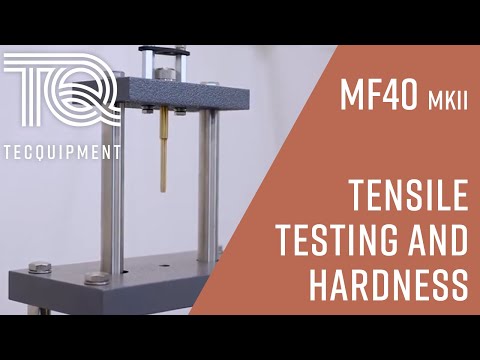
Materials Laboratory for Tensile Testing and Hardness Testing
-
 MATERIALS LABORATORY WITH DATA CAPTURE
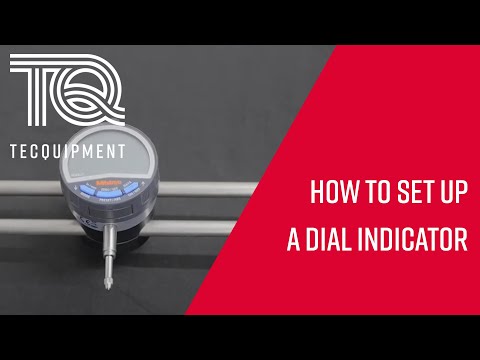
How to Set Up Your Dial Indicator / Mitutoyo Dial Indicator for VDAS® | Quick & Correct Guide
Experiment
DefleX-2D
DefleX®-2D
Experiment
DefleX-3D
DefleX®-3D
Ancillary
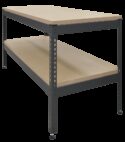
WB1
Work Bench
Experiment
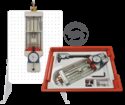
ES6
TENSILE TESTER KIT
Experiment
SM1000
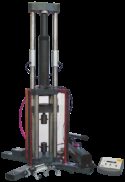
UNIVERSAL TESTING MACHINE
Experiment
SM1002