

Experiment
CE110
SERVO TRAINER
A self-contained, benchtop DC servo apparatus to study basic control of speed of a servomotor, through to more advanced studies of non-linear effects of hysteresis, deadzone and saturation.


If you have any questions or you'd like to discuss a product, please call us.
+44 1159 722 611SERVO TRAINER
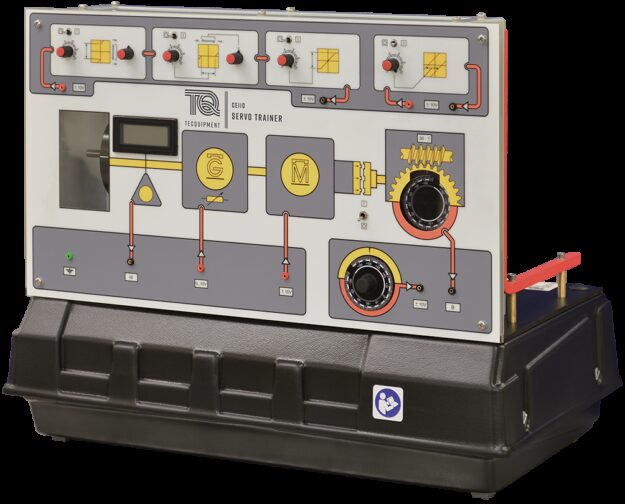
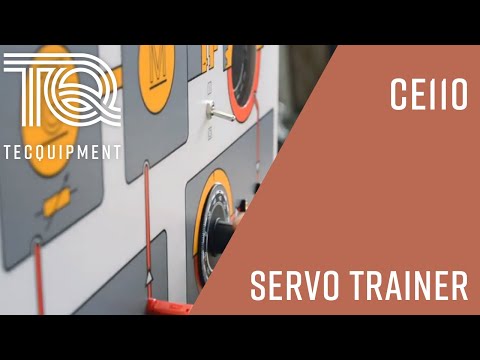
The CE110 Servo Trainer shows DC servo position and speed control systems using typical industrial techniques. It has a DC servomotor, a DC generator and a flywheel mounted on a common shaft.
Analogue 0 to ±10 V control signals vary the servomotor shaft speed in either direction. An optical sensor measures the speed and shows it on a panel-mounted digital meter. The DC generator statically or dynamically loads the servomotor. An electric clutch connects or disconnects the shaft to a 30:1 reduction gearbox for position control studies. A manual control allows the user to set a position control setpoint.
To adjust the shaft inertia, the CE110 comes with two extra interchangeable inertia discs (flywheels).
For advanced experiments, the Servo Trainer includes extra ‘block’-type circuits that can add non-linear and fully adjustable effects of:
- Deadzone or ‘deadband’
- Anti-deadzone
- Hysteresis
- Saturation
These blocks are important in studies of servo systems because they mimic problems that happen in real applications.
Key features
- Self-contained and compact benchtop unit for basic control of speed, with advanced studies of non-linear effects of hysteresis, deadzone and saturation
- Demonstrates the problems of speed and position control of a servomotor under different loads
- Mimics industrial, transport and aeronautical problems, with realistic results
- All inputs and outputs buffered for connection to TecQuipment’s optional controllers or other suitable controllers
- Front panel includes a mimic diagram of the process so that students can see what they are controlling
Essential Base Unit
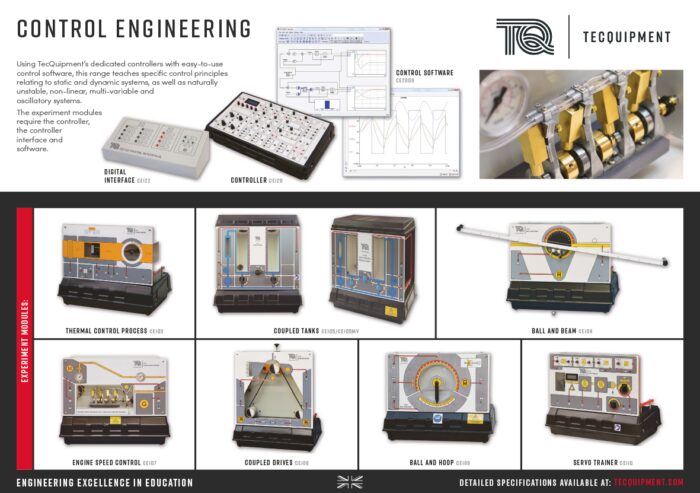
- Controller (CE120) – A controller with analogue and digital controls and instruments
or
- Digital Interface (CE122) – An interface which connects
between most products in the Control Engineering
range and a suitable computer (not included)
or
- Other suitable controller with +/– 10 V inputs and
outputs
Both the CE120 and the CE122 include TecQuipment’s CE2000 Control Software (see separate datasheet) with editable, pre-made control experiments for use with the CE110.
Learning outcomes
- Basic tests and transducer calibration
- Response calculation and measurement
- Proportional and proportional plus integral control of servo-system speed
- Disturbance cancelling and feedforward control
- Angular position control: proportional control and velocity feedback
- Angular position control and the influence of nonlinearities
- Non-linear system characteristics
The flexible design of the equipment allows the user to develop many other analysis and control exercises to suit their needs. It is good for extended or advanced control experiments, and is ideal for student project work.
-
 SERVO TRAINER
Servo Trainer - TecQuipment
Ancillary
WB1