

Experiment
TM161
SIMPLE AND COMPOUND PENDULUMS
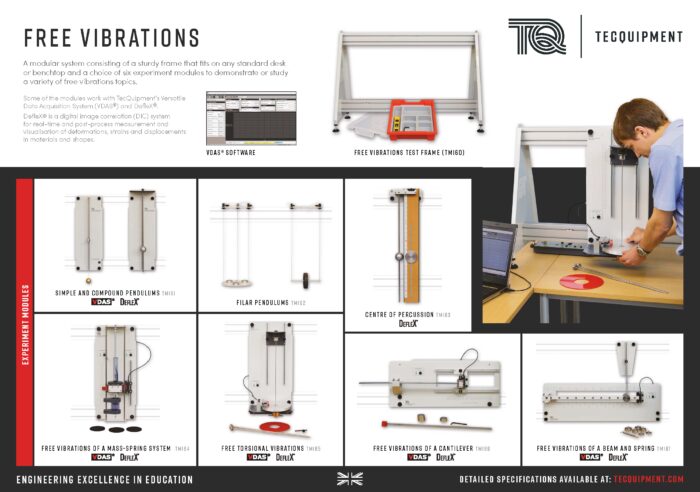
Experiment for studying simple harmonic motion and the factors that affect the period of oscillation of pendulums. Fits on to the Free Vibrations Test Frame.





If you have any questions or you'd like to discuss a product, please call us.
+44 1159 722 611Upgrade to package
SIMPLE AND COMPOUND PENDULUMS
This product is part of a range that explores free vibrations in simple ‘one degree of freedom’ systems.
It introduces students to key scientific terms such as:
- Simple harmonic motion (SHM) and period of oscillation
- Mass moment of inertia
- Radius of gyration
- Routh’s rule
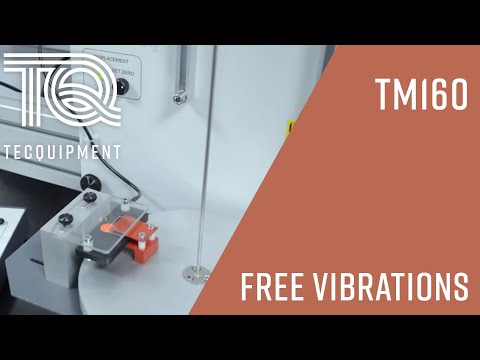
This product fits to the sturdy Test Frame (TM160) for study or demonstration.
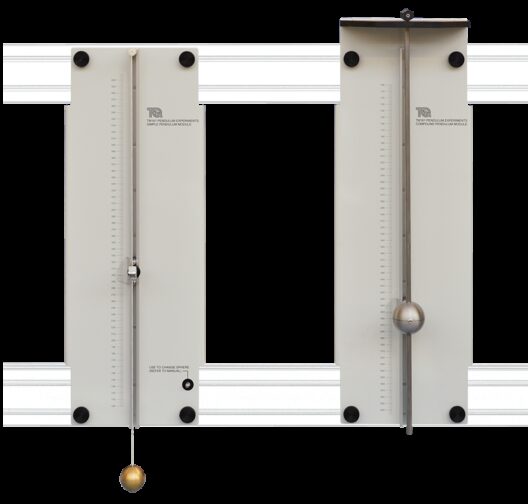
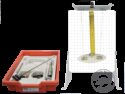
This product includes a simple pendulum and a compound pendulum. Both pendulums swing through small angles, showing the principles and use of simple harmonic motion using the small angle approximation.
The simple pendulum uses a cord which may be considered as ‘light’ so you can ignore its mass, leaving only the sphere and cord length as the important variables.
The compound or ‘physical’ pendulum uses a ‘heavy’ solid rod which has reasonable mass, so you must allow for it in theoretical equations.
Each pendulum has a back panel that fixes separately to the Test Frame. The back panel of each pendulum has an accurate scale and indicator, referenced to pendulum pivot or centre of mass points. This improves measurement accuracy - essential for good results.
The simple pendulum has a choice of two spheres suspended by a cord. An adjustable indicator also acts as the pendulum pivot point - allowing you to adjust the cord length in seconds. This can also provide a quick visual demonstration of the effect of cord length on period. Each sphere has a different mass for comparison and an internal spring retainer so you can easily swap them between experiments.
The compound pendulum has a solid rod that pivots on a hardened steel knife edge on the upper surface of a steel platform. This pendulum includes an additional spherical mass that fixes at any position along the rod. It also includes an extra pivot and disc-shaped mass so you can convert it for use as a Kater’s pendulum.
The Kater’s pendulum works as a reversible and adjustable compound pendulum. Students adjust the relative positions of its parts until they have equal time periods in both its standard and reversed arrangements. It then works as an accurate gravimeter.
Students test different pendulums to see how different factors, such as mass or pendulum length affect simple harmonic motion and the period of oscillation. The theory shows how to predict the period of oscillation of a given pendulum for comparison with actual results. It also shows how pendulums can produce an approximate value of the acceleration due to gravity.
View the Free Vibrations experiment flyer here.
DefleX® is a complementary tool designed to introduce students to the concept and technique of Digital Image Correlation (DIC). This product is compatible with our DefleX®-2D product that uses one video camera and our DefleX®-3D product that uses two video cameras to track the movement of materials during a dynamic event. They are complete and compact systems for measuring full-field displacements and strains over a material’s surface in two and three dimensions, offering students a digital blended learning experience as part of their engineering courses.
Key features:
- One of a series of modular experiments that explore free vibrations in simple systems
- Quick and easy assembly
- Safe for students to use, needing minimal laboratory supervision
- Two modules: a simple pendulum and a compound pendulum for a range of experiments
- Back panels with referenced scales and sliding indicators for accurate positioning of pendulum parts
- The simple pendulum has unique quick-change spheres and adjustable cord length to save time
- The compound pendulum includes extra parts to work as a Kater’s pendulum
- Contains all parts needed for the experiments, including a stopwatch and tools
- Compatible with our DefleX® system
Learning outcomes
- Cord length and period of a simple pendulum.
- Mass and period of a simple pendulum.
- Using a simple pendulum to find the acceleration due to gravity.
- Centre of gravity and period of a compound pendulum.
- How an adjustable mass affects the period of a compound pendulum.
- Using a Kater’s pendulum to find the acceleration due to gravity.
-
 SIMPLE AND COMPOUND PENDULUMS
Free Vibrations TM160 Series - TecQuipment
Experiment
DefleX-3D
DefleX®-3D
Experiment
ES7